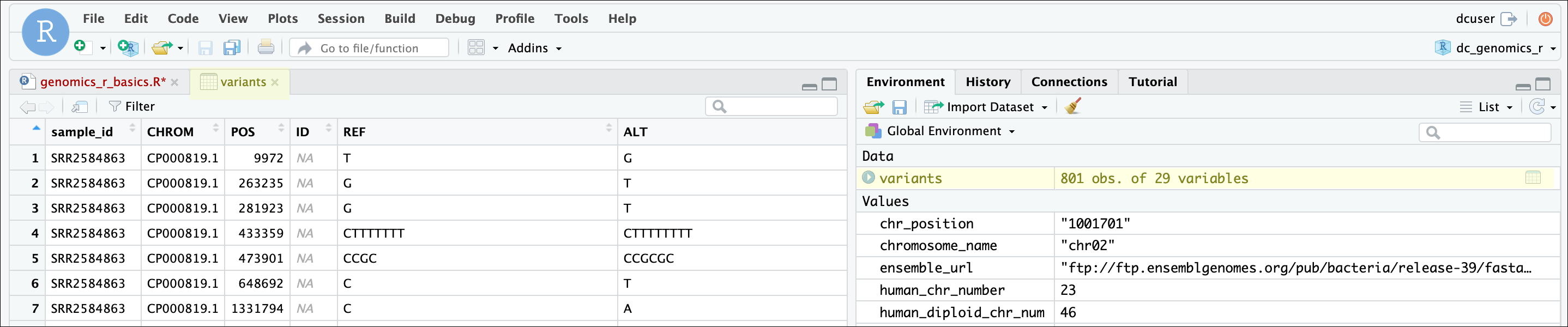
R Dataframe Tutorial. In this r tutorial, we learned what a. You'll see more about their functionalities and their usage later on in this tutorial!
R Basics continued factors and data frames Intro to R from datacarpentry.org
It is super fast and has intuitive and terse syntax. Plus a tips on how to. Two or more data frames.
Explain How To Retrieve A Data Frame Cell Value With The Square Bracket Operator.
This example explains how to create an array based on two input data frames in the r programming language. Drop columns of r dataframe. If you are trying to understand the r programming language as a beginner, this tutorial will give you enough understanding on almost all the concepts of the language from where you can take yourself to higher levels of.
We’re Going To Walk Through How To Sort Data In R.
We shall look into following items to access meta information and data of an r data frame : Two or more data frames. Let’s put these data frames into an array!
Accessing The Elements Of The Dataframe;
If you want to learn more about the arguments that you can use in the read.table(), read.csv() or read.csv2() functions, you can always check out our reading and importing excel files into r tutorial, which explains in great detail how to use the read.table(), read.csv() or read.csv2() functions. If you want to learn more from this course, here is the link. Dataframes also allow you to intermix operations seamlessly with custom python, sql, r, and scala code.
How To Create A Dataframe;
The data is stored in cells which are accessed by specifying the corresponding [row, col] set of values of the data frame. A data frame is a special case of the list in which each component has equal length. Data.frame(z = rnorm(100)) %$% ts.plot(z) of course, these three operators work slightly differently than the main %>% operator.
Subsetting In R Is A Useful Indexing Feature For Accessing Object Elements.
We also provide a sample notebook that you can import to access and run all of the code examples included in the module. Using the dataframe sort by column method will help you reorder column names, find unique values, organize each column label, and any other sorting functions you need to help you better perform data manipulation on a multiple column dataframe. > df1 = data.frame(x = c(9, na, 7, 4), y = c(4, na, na, 21)) > df1 x y 1 9 4 2 na na 3 7 na 4 4 21.
Comment Policy: Silahkan tuliskan komentar Anda yang sesuai dengan topik postingan halaman ini. Komentar yang berisi tautan tidak akan ditampilkan sebelum disetujui.